
What Is PP Material?
PP, or polypropylene, is a polymer formed by the polymerization of propylene. It is a white, waxy material that is transparent in appearance and lightweight in texture.
With low density, PP offers superior strength, hardness, and heat resistance compared to low-density polyethylene, maintaining performance around 100°C.
Below 80°C, it resists corrosion from acids, alkalis, salt solutions, and various organic solvents, though it decomposes under high temperatures and oxidation.
PP also exhibits excellent chemical resistance, heat resistance, electrical insulation, high mechanical strength, and good wear resistance during processing.
Since its introduction, it has been extensively developed and applied across numerous fields including machinery, automotive, electronics, construction, textiles, packaging, agriculture, forestry, fisheries, and the food industry.

Key Advantages of PP Lab Furniture
1. Physical Properties
PP is a non-toxic, odorless, and tasteless milky-white highly crystalline polymer with a density of only 0.90–0.91 g/cm³, making it one of the lightest plastics currently available.
Its products feature a good surface gloss and are easy to color.
2. Mechanical Properties
PP possesses high crystallinity and a regular structure, resulting in excellent mechanical properties.
3. Thermal Properties
PP exhibits good heat resistance. Products can withstand sterilization at temperatures above 100°C and remain deformation-free at 150°C without external force.
Its brittle temperature is -35°C; below this temperature, brittleness occurs, making its cold resistance inferior to polyethylene.
4. Chemical Stability
PP exhibits exceptional chemical stability, resisting most reagents except concentrated sulfuric acid and nitric acid.
Low-molecular-weight aliphatic hydrocarbons, aromatic hydrocarbons, and chlorinated hydrocarbons can soften and swell PP. Its chemical stability increases with higher crystallinity, making PP suitable for various chemical pipelines and fittings with notable corrosion resistance.
5. Electrical Properties
PP has a relatively high dielectric constant that increases with temperature, making it suitable for heat-exposed electrical insulation products.
Its high breakdown voltage makes it suitable for electrical fittings. While PP exhibits good voltage resistance and arc resistance, it has relatively high static electricity and may age when in contact with copper.
6. Environmental Friendliness and Structural Stability
PP lab furniture reduces environmental pollution and safeguards user health.
The cabinet body employs one-piece molding and seamless welding technology, significantly enhancing structural integrity and effectively minimizing deformation caused by thermal expansion and contraction.

Common Types of PP Lab Furniture
With exceptional resistance to strong acids, strong alkalis, and corrosion, PP material is suitable for various laboratories. Common PP lab furniture includes:
- PP Lab Benches
- PP Fume Hoods
- Polypropylene PP Storage Cabinets
- PP Material Hazardous Chemical Storage Cabinet
- Open-style PP shelving
- PP Material Glassware Storage Cabinet
- PP Trays
These products are suitable for high-cleanliness laboratories such as pharmaceutical labs, food testing facilities, semiconductor labs, trace metal analysis labs, and biological research laboratories.

Core PP Lab Furniture Components
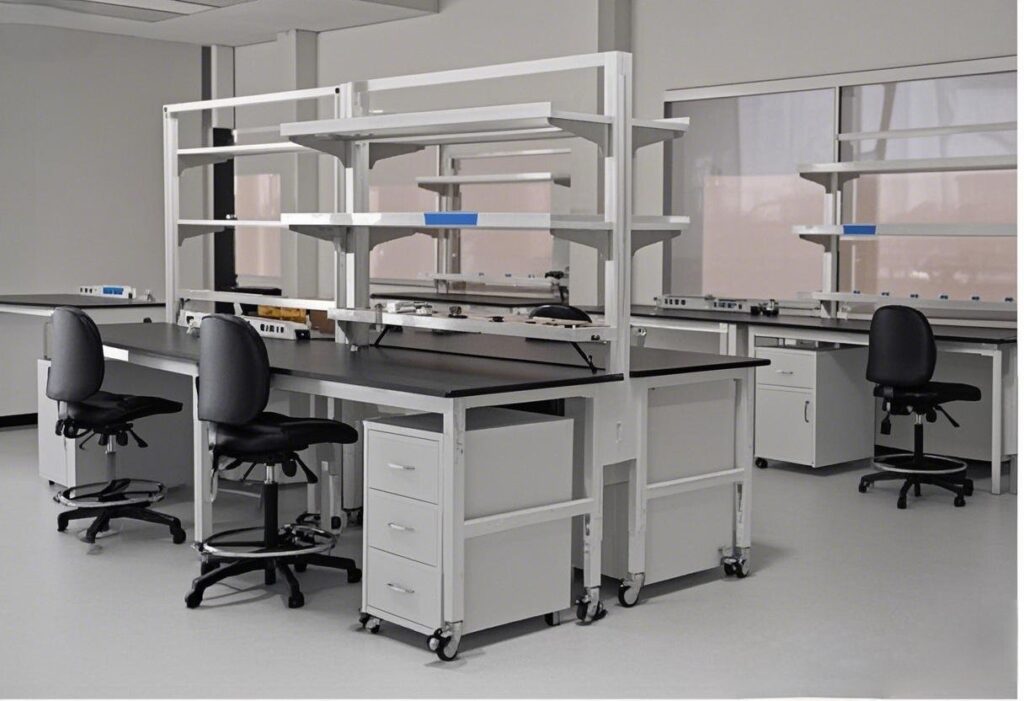
1. PP Lab Bench
- Cabinet and Drawer Doors: Constructed from 8-12mm premium porcelain-white PP with exceptional acid and alkali resistance. CNC precision-cut and welded into a seamless monolithic structure using color-matched, homogeneous welding rods. Features no sharp edges and offers near-permanent service life.
- Worktop: Constructed from 12mm PP sheet. Alternatives include phenolic resin, Qiansi board, epoxy resin, or ceramic worktops.
- Fittings: Installed with precision, ensuring flush, level, and secure alignment. Joints exhibit no chipping or looseness.
- Clearance Requirements: 1-3mm gap between doors and frames, doors and doors, doors and drawers; top edge trim fits snugly with ≤0.5mm deviation from panel length; cable access holes with ≤0.5mm dimensional tolerance; drawer sag ≤20mm and sway ≤10mm when fully extended; uniform countertop chamfers with ≤2mm radius. Overall requirements: Level and stable.
- Hinges and handles: Manufactured from homogeneous PP polypropylene material resistant to strong acids and alkalis.
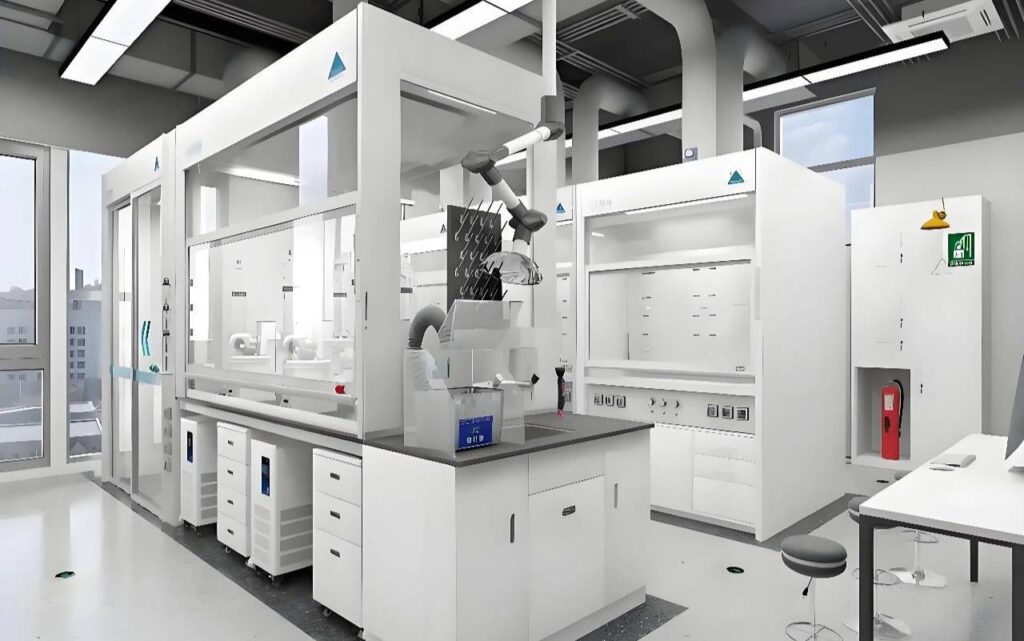
2. PP Fume Hoods
- Cabinet body: Constructed from 8-12mm premium porcelain-white PP with excellent acid and alkali resistance. CNC precision-cut and finished with same-color, homogeneous weld rod for seamless integration, ensuring no sharp edges.
- Upper Cabinet: Features a canopy-style exhaust design with one ∮250mm PP exhaust hood. Baffle plates are made of homogeneous PP material with excellent acid and alkali resistance. Installation dimensions are scientifically optimized to eliminate airflow dead zones, achieving outstanding fume capture and effectively removing odors and moisture.
- Lower Cabinet: Serves as storage with an additional middle shelf. Hinges are made of PP material, while handles feature PP C-shaped pulls, offering good corrosion resistance.
- Worktop: Constructed from 12mm PP board. Optional surfaces include phenolic resin, quartz, epoxy resin, or ceramic. Sinks can be configured per user requirements.
- Adjustable Door:Glass:
- Glass: Constructed from 4mm thick transparent acrylic glass with excellent acid and alkali resistance.
- Frame: Features thick porcelain-white PP C-channel profiles with an embedded joint for safety and durability.
- Suspension Belt: Each fume hood’s adjustable door utilizes a belt connection system.
- Balancing Counterweight: Incorporates a stepless counterweight box design. Vertical travel is restricted by silent tracks to prevent swaying and collisions.
- Electrical Equipment:
- Switches: Illuminated push-button self-locking switches, including fan, lighting, and main power controls.
- Lighting: Fully enclosed triple-proof fixtures with 220V×20W×2 bulbs housed within the lampshade.
- Outlets: Each fume hood equipped with 2 splash-proof 220V 10A power outlets.
3. Polypropylene PP Storage Cabinets
- Cabinet Body: Constructed entirely from 8-12mm premium porcelain-white PP with excellent acid and alkali resistance. CNC precision-cut and welded into a seamless monolithic structure using color-matched, homogeneous welding rods. Features no sharp edges and offers near-permanent service life.
- Viewing Window: Made of transparent glass for easy inspection of internal contents.
- Fittings: Installed with precision, ensuring a flush, level, and secure fit. Joints exhibit no chipping or looseness.
- Gap Requirements: 1-3mm clearance between doors and frames, and between doors. Top edge trim fits snugly with ≤0.5mm deviation from panel length. Cable access holes have ≤0.5mm dimensional tolerance. Entire unit must be level and stable.
- Hinges & Handles: Constructed from homogeneous PP polypropylene material resistant to strong acids and alkalis.

Comparison of PP Lab Furniture and Steel Lab Furniture
1. Corrosion Resistance
- PP Material: Inherently exhibits exceptional resistance to strong acids, strong alkalis, and organic solvents. Requires no additional anti-corrosion treatment, making it suitable for lab environments involving prolonged exposure to chemical reagents.
- Steel Furniture: Typically relies on coatings like spray painting or galvanization for corrosion protection. Once the coating is damaged, it becomes prone to rust and corrosion, rendering it unsuitable for highly corrosive chemical environments.
2. Weight and Installation
- PP Material: With a density of only 0.90–0.91 g/cm³, it is lightweight, facilitating easy handling and installation without heavy equipment.
- Steel Furniture: High density and weight necessitate multiple installers or tools, imposing load-bearing requirements on the installation site.
3. Structural Stability
- PP Material: Utilizes seamless welding technology for monolithic construction, eliminating joints and effectively resisting thermal expansion/contraction deformation, ensuring extended service life.
- Steel Furniture: Typically features assembled joints that may loosen over time. Temperature fluctuations can cause paint cracking and minor cabinet deformation.
4. Environmental Friendliness and Safety
- PP Material: Non-toxic, odorless, and chemically stable, it does not release harmful substances, safeguarding experimenter health. It is recyclable and environmentally friendly.
- Steel Furniture: Coatings may contain volatile substances. Rust particles from damaged surfaces can contaminate the lab environment. Some low-cost products carry risks of formaldehyde exceeding safety standards.
5. Pricing and Applications
- PP Material: Slightly higher priced than standard steel furniture due to material properties and manufacturing processes. Primarily suited for highly corrosive environments like chemical, pharmaceutical, and trace metal laboratories.
- Steel Furniture: More affordable with superior load-bearing capacity. Ideal for general physics labs, sample storage rooms, and other non-corrosive settings requiring frequent heavy loads.

Why Choose PP Lab Furniture?
PP material boasts exceptional resistance to acids, alkalis, and corrosion. PP lab benches and other furniture utilize seamless welding technology for one-piece construction, significantly enhancing cabinet structural integrity and effectively reducing deformation caused by thermal expansion and contraction.
They withstand erosion from strong acids, alkalis, and other chemicals, resisting impact damage, corrosion, and rust. As the optimal material choice for all types of lab furniture, PP units typically command a slightly higher price than alternatives.
Would love to constantly get updated outstanding weblog! .